In my previous post, I briefly touched upon the importance of using old Chinese sources for reconstructing the historical geography of Southeast Asia and touched on possible references to the eastern archipelago of present-day Indonesia. If you have not read that post, I recommend starting there.
At this point, I want to draw some attention to a great source on Chinese knowledge of the world beyond their shores in the third century CE.
Maritime Asia in the Third Century CE translated and edited by Andrew Chittick
In the website linked above, historian Andrew Chittick reconstructs and translates surviving excerpts from Account of Foreign Countries in the Wu Period (Wúshí Wàiguó Zhuàn 吳時外國傳) written by Kang Tai (Kāng Tài 康泰) in the mid-third century CE. As with many other ancient and classical texts, Kang Tai’s text has been lost to history. Fortunately, portions of it survive through quotations in later works, most notably the Book of Liang (Liáng Shū 梁書) of the seventh century CE and the Taiping Yulan (Tàipíng Yùlǎn 太平御覽) compiled in the tenth century.
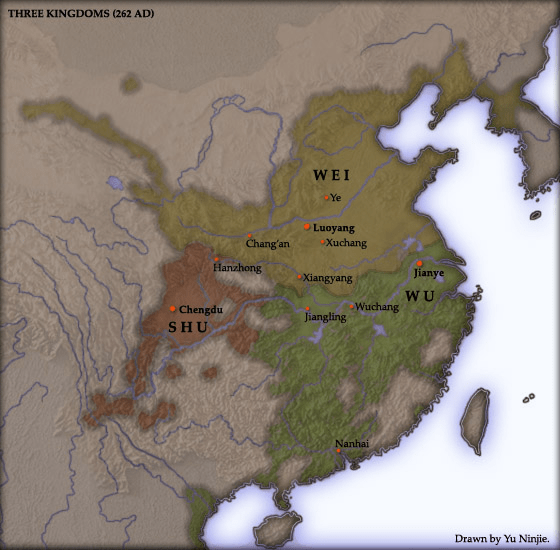
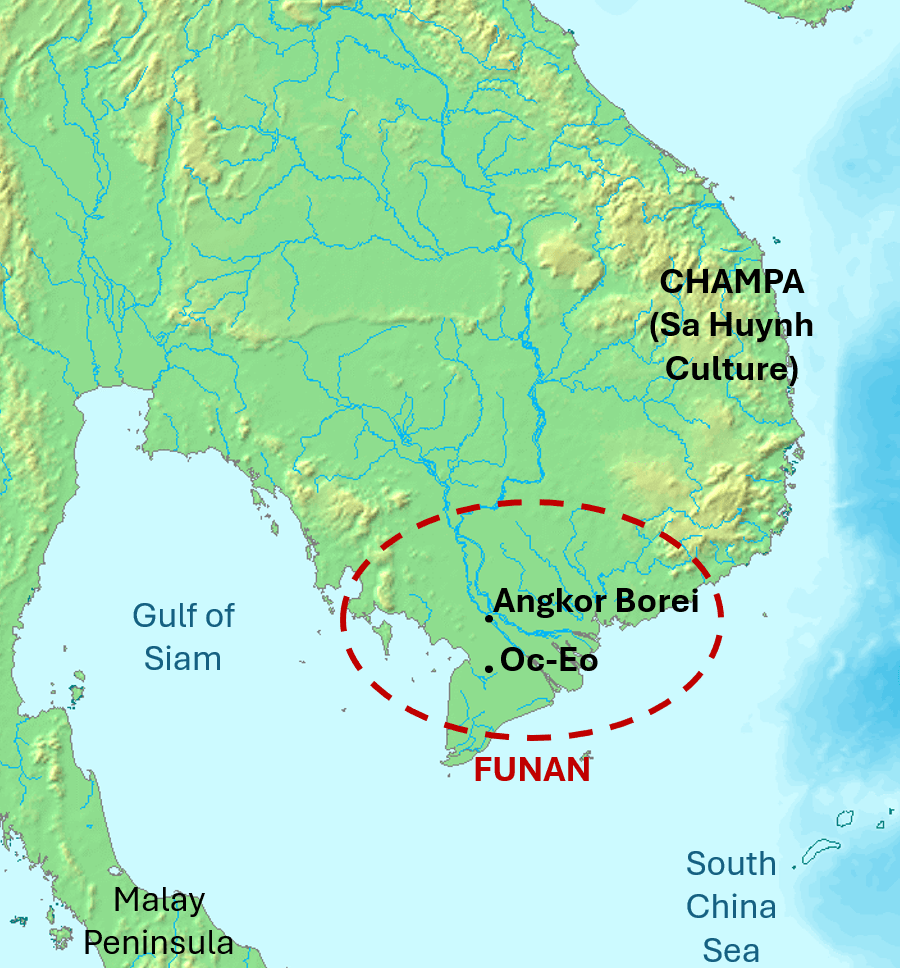
As one of two emissaries from the state of Wu (Wú 吳), one of the post-Han Dynasty states of the Three Kingdoms Era (220-280 CE), Kang Tai was sent to the Mainland Southeast Asian polity of Funan (Fúnán 扶南), based in what is today the Mekong Delta area of Cambodia and southern Vietnam. His account recorded information not only about Funan but also about lands connected by the major maritime trade routes extending across Southeast Asia, South Asia, Persia, and even Rome.
In Funan, which included the important archaeological site of Oc Eo, Kang Tai would almost certainly have encountered the trading of commodities like nutmeg and cloves. And, while Kang Tai did not necessarily travel to the region where these spices originated, he seems to have inquired about their places of origin.
According to the later texts preserving his work, Kang Tai wrote that across the sea east of Funan lay a large island containing a country called Zhubo (Zhūbó 諸簿), and farther east was another island named Mawu (Máwǔ 馬五).
In my previous post, I discussed the limitations of simply rendering these names into modern Hanyu Pinyin, which reflects contemporary Mandarin pronunciation rather than the sounds of earlier periods. Reconstructions of Middle Chinese (roughly the fourth through twelfth centuries CE) instead suggest pronunciations approximating Tsyo bak for Zhubo (諸簿) and Ma ngu for Mawu (馬五).
As Chittick notes, many historians believe Zhubo (Tsyo bak) refers to Java. What interests me most, however, is Mawu (Ma ngu).
According to those later texts that cite Account of Foreign Countries in the Wu Period, Kang Tai writes: 諸薄之東有馬五洲,出雞舌香,樹木多華少實。
Chittick translates this as “East of Zhubo is the land of Mawu. It produces chicken-tongue aromatic (cloves). The trees have many flowers but little fruit.”
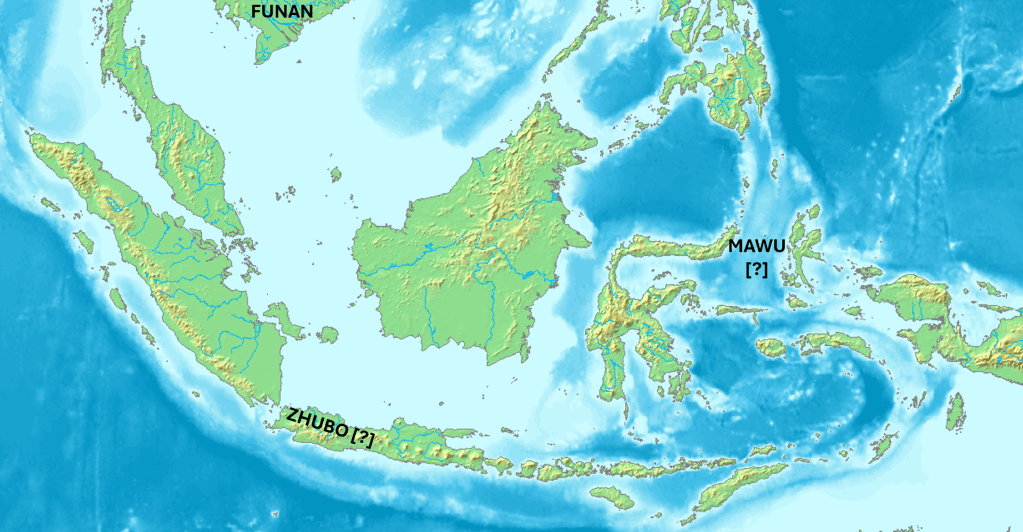
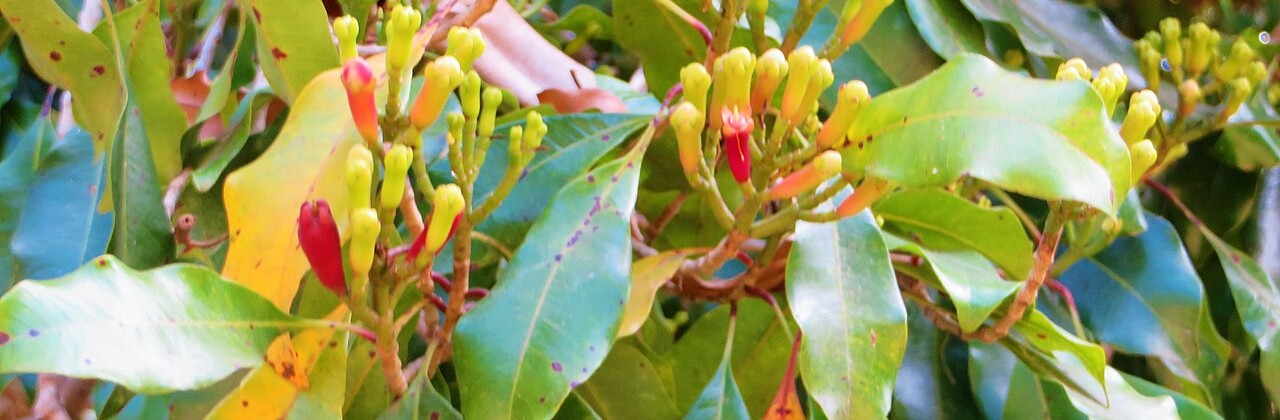
The crucial phrase here is “chicken-tongue aromatic” (jīshéxiāng 雞舌香). Chittick identifies this as cloves (Syzygium aromaticum), a species indigenous to the islands of present-day North Maluku in eastern Indonesia. If this identification is correct, then Mawu (Ma ngu) may represent one of the earliest Chinese references to Maluku.
Chittick is far from alone in making this identification. Many historians of classical Chinese medicine and food have likewise interpreted “chicken-tongue aromatic” as cloves. The interpretation is not universally accepted, however. Historian Liam Kelley, for example, argues in this blogpost that “chicken-tongue aromatic” was not cloves.
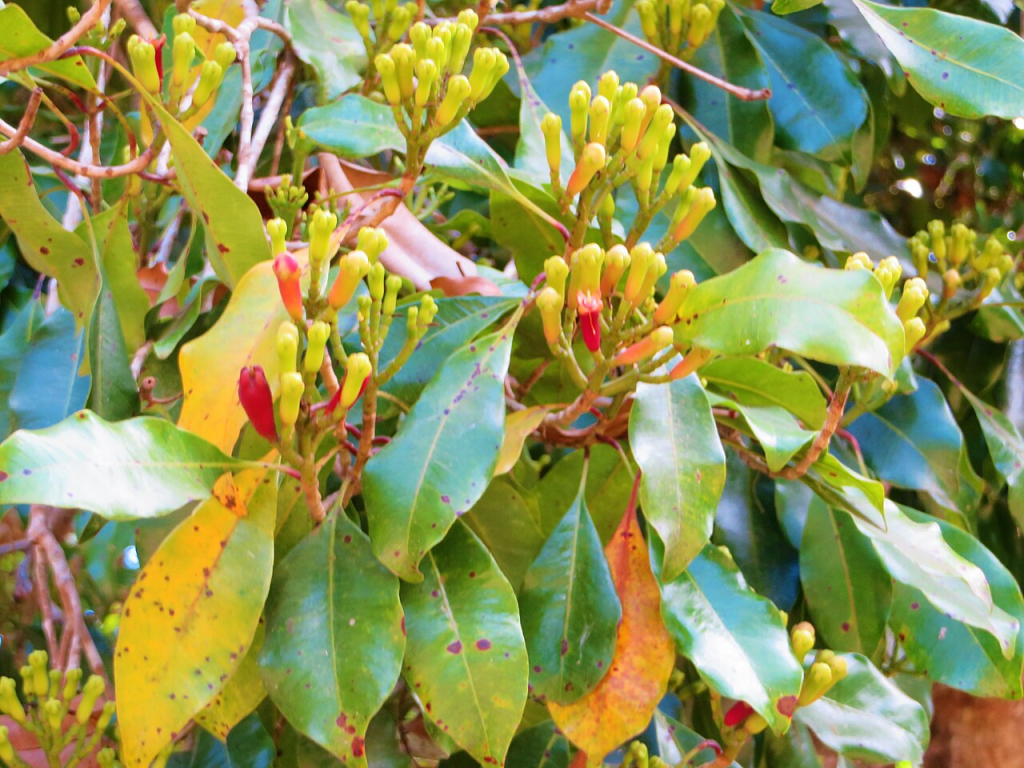
However, if we do accept with reservations that this “chicken-tongue aromatic” does indeed refer to cloves, then Chinese knowledge of eastern archipelago spices may predate the third century CE when Kang Tai produced his Account of Foreign Countries in the Wu Period. Several accounts traced to the Han Dynasty (202 BCE-220 CE) mention this spice. These references, however, require particular caution. This is because, like Kang Tai’s Account of Foreign Countries in the Wu Period, these accounts are only known through references found in sources from much later periods.
In some Song Dynasty (960-1279 CE) accounts, it is narrated that an elderly Han Dynasty palace attendant, named Ying Shao (Yīng Shào 應劭; 140-206 CE), was given “chicken-tongue aromatic” to put in his mouth to freshen his breath before his audience with the emperor. This tale is particularly noteworthy as Ying Shao was a prominent Han Dynasty official and the author of the Ceremonials for Han Dynasty Officials (Hàn Guān Yí 漢官儀), another text largely known through later sources.
In one text completed in 624 CE, it is stated Ying Shao’s Ceremonials for Han Dynasty Officials mentions the gifting of “chicken-tongue aromatic” to a different palace official with bad breath. In another text completed in the tenth century CE, Ying Shao’s Ceremonials for Han Dynasty Officials is quoted as stating that this interaction took place during the reign of Emperor Huan (Hàn Huán Dì 漢桓帝; r. 146–168).
If it is accepted that this “chicken-tongue aromatic” did indeed refer to cloves and that these later quotations accurately preserve Ying Shao’s original text, then it appears that cloves have been consumed in China since the second century CE or earlier. Both assumptions, however, remain open to debate, and neither should be accepted uncritically.
Returning to Kang Tai’s Account of Foreign Countries in the Wu Period, I cannot say with certainty that the “chicken-tongue aromatic” was cloves, nor that Mawu (Ma ngu) referred to Maluku. Both identifications remain plausible rather than proven. Nonetheless, taken together, they raise the intriguing possibility that Chinese merchants had access to products from the eastern archipelago through maritime trade networks as early as the second or third century CE. Even if that was the case, it is still unlikely that Chinese sailors themselves routinely voyaged as far as the eastern archipelago during this period. More likely, these commodities passed through a series of intermediary trading networks before eventually reaching China.
Additional References
Milburn, Olivia. “Aromas, Scents, and Spices: Olfactory Culture in China before the Arrival of Buddhism.” Journal of the American Oriental Society 136, no. 3 (2016): 441–64.
 Benjamin L. Moseley
Leave a comment